If you are thinking about buying a condo in Brookline, you have probably noticed one thing right away: this is not a bargain market. Brookline condos are often priced above nearby Boston, Cambridge, and Newton, and limited inventory means well-positioned units can move quickly. The good news is that once you understand how Brookline’s condo market works, you can make smarter decisions about budget, location, and long-term value. Let’s dive in.
Why Brookline Condos Stand Out
Brookline has a very specific market structure that shapes condo demand. The town sits about four miles from downtown Boston and is surrounded by Boston on three sides, with less than 6% of its land zoned commercial, according to the Town of Brookline. That helps explain why condo demand tends to cluster around walkable commercial areas and transit corridors instead of spreading evenly across town.
This creates a market where location carries real weight. In places tied closely to daily convenience, transit access, and neighborhood services, buyers are often willing to pay more for a smaller but better-positioned home.
Brookline Condo Prices Right Now
Current data points to a tight market with limited supply. The Massachusetts Association of Realtors January 2026 Brookline update reported 50 condo listings, 1.4 months of supply, and a $1.16 million median condo sale price year to date. That closed-sale data lines up with the broader takeaway that Brookline condos sit in a higher-priced segment of the Greater Boston market.
For context, asking-price snapshots from the same period show Brookline condos around a $1.1 million median listing price, compared with about $850,000 in Boston, $899,000 in Cambridge, and $887,000 in Newton. Even allowing for the difference between listing prices and closed sales, Brookline clearly reads as a premium condo market.
What Drives Demand in Brookline
Brookline’s strongest condo demand usually centers on areas where you can pair housing with convenience. The town’s Green Line network includes the C and D branches, the 66 bus connects Brookline Village and Coolidge Corner with Boston and Cambridge, and Bluebikes stations are located in Brookline Village, Coolidge Corner, JFK Crossing, and Washington Square.
That transit access matters because many buyers are not just shopping for square footage. They are also shopping for an easier commute, walkable errands, and proximity to restaurants, shops, and services. In Brookline, that often means smaller condos in prime locations can compete very well against larger units farther from the main corridors.
Common Brookline Condo Types
One of the most interesting parts of the Brookline condo market is its variety. You are not looking at one standard building style or one predictable ownership model.
Older Buildings and Conversions
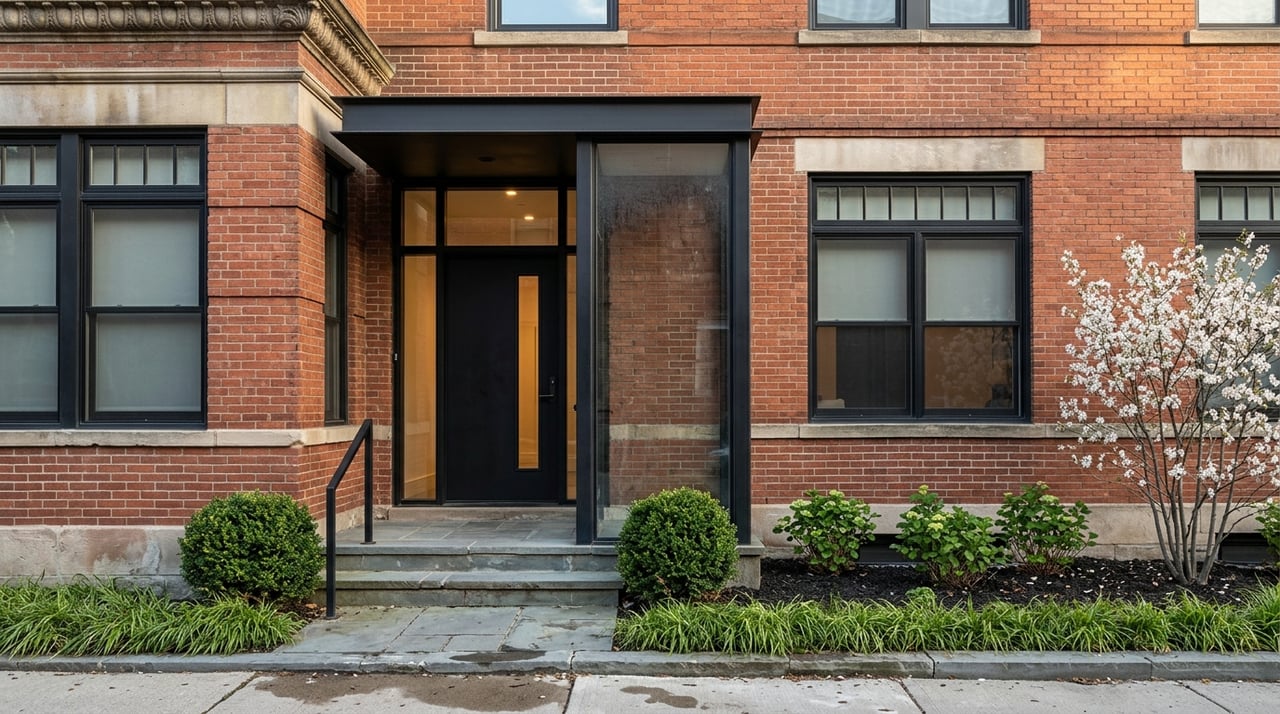
Many Brookline condos are found in older buildings, especially in transit-oriented areas. The Coolidge Corner district plan notes that many buildings in that area were built between 1890 and 1930, and the district includes a wide mix of architectural styles.
That often translates into condos with classic details, smaller associations, and layouts that may differ from newer construction. Some buyers love that character. Others focus more on whether the building’s systems, reserves, and common areas have been kept up over time.
Historic and Unusual Housing Forms
Brookline’s condo inventory also includes more distinctive historic properties. The town’s walking-tour materials highlight Beaconsfield Terraces, an early-1890s residential complex where owners shared a large park and amenities.
That is a useful reminder that Brookline condos are not limited to simple apartment-style buildings. Some properties come with a strong sense of architectural identity, and that can be a meaningful part of their appeal and value.
Full-Service and Amenity Buildings
At the other end of the market, Brookline also offers later 20th-century and higher-service buildings. These can include elevator buildings, garage parking, concierge service, fitness spaces, pools, and broader shared amenities.
In these communities, you may pay more each month, but you may also get more convenience and less day-to-day maintenance responsibility. For some buyers, especially those relocating or downsizing, that tradeoff is worth it.
What Different Budgets Can Buy
Brookline offers a range of condo options, but your price point will strongly shape what type of home is realistic.
Under $600K
At this level, you will usually see compact studios or one-bedroom units in older or less amenity-heavy buildings. These can be a practical entry point if your priority is Brookline location over size.
About $700K to $900K
This range often includes smaller two-bedroom condos or older units with modest updates. Buyers in this category usually need to balance condition, layout, and location carefully.
Around $1M to $1.5M
In this bracket, you are more likely to find larger two-bedroom homes or smaller three-bedroom units, often in stronger locations and with more renovation work already done. This is where many buyers start seeing a more complete blend of space, finish quality, and convenience.
$1.5M and Up
At the upper end, you are generally looking at premium locations, larger floor plans, luxury finishes, outdoor space, parking, or full-service amenities. In Brookline, high-end condos can compete with luxury offerings in some of Greater Boston’s most expensive submarkets.
Condo Fees and Monthly Costs
List price is only part of the picture in Brookline. Your actual monthly cost can vary widely depending on condo fees, taxes, and building structure.
According to Massachusetts condominium guidance, condo fees are based on the annual budget, are usually paid monthly, and associations are required to maintain an adequate replacement reserve fund. The guidance also explains that associations generally insure common areas through a master policy, while unit owners carry coverage for what that policy does not include.
In practice, Brookline condo fees can range from relatively low in self-managed or smaller buildings to much higher in full-service communities. The difference often comes down to what is included, such as heat, water, elevator service, concierge support, pool access, gym facilities, trash, insurance, and reserve contributions.
Brookline Taxes Matter Too
Property taxes can significantly affect affordability, especially when two condos have similar prices but different tax treatments. The town uses a split tax rate, and eligible owner-occupants may qualify for a residential exemption. Brookline also applies a 1% Community Preservation Act surcharge on property tax bills.
That means your ownership cost should always be reviewed as a full monthly number, not just as mortgage plus condo fee. Taxes, exemptions, and surcharges can materially change the total.
Features That Support Value
In Brookline, value often rises with a specific group of features. Transit access, walkability, parking, natural light, outdoor space, and renovation quality tend to matter a lot.
Feature data in Brookline also points to buyer interest in items like pantry space, in-unit laundry, open floor plans, hardwood floors, balconies, and updated finishes, according to Redfin’s Brookline home trends. Even in a strong market, the details still shape how buyers respond to a home.
Historic Districts and Renovation Limits
Brookline’s preservation framework is broad, with 8 local historic districts and 16 National or State Register districts, according to the town’s historic places overview. If you are buying in one of these areas, it is important to know that exterior changes may be subject to review.
The town’s preservation commission guidance explains that this review process is meant to preserve exterior character. For buyers, that can be a plus because it helps support streetscape consistency and neighborhood appeal. It can also mean less flexibility if you hope to make major exterior changes later.
How to Approach a Brookline Condo Search
A successful Brookline condo search usually starts with priorities, not just price. Before you tour homes, it helps to rank what matters most to you.
You may want to focus on:
- Commute access to the Green Line or key bus routes
- Walkability to commercial centers like Coolidge Corner, Brookline Village, or Washington Square
- Parking needs
- Building style and level of amenities
- Condo fee tolerance
- Renovation condition versus willingness to update
- Historic district considerations
In Brookline, one of the biggest mistakes buyers make is comparing condos only by size. A smaller, well-located condo with better light, parking, and lower friction in daily life may hold its value better than a larger unit in a less convenient spot.
Why Guidance Matters in This Market
Because Brookline’s condo inventory is limited and highly varied, two homes at similar price points can offer very different value. One may have lower fees but fewer reserves. Another may be beautifully renovated but come with higher monthly carrying costs. A third may have excellent transit access and long-term appeal, even if the square footage is modest.
That is where a local, detail-oriented strategy matters. If you are buying in Brookline, you want to look beyond the listing photos and understand the full ownership picture, including location dynamics, building structure, fee composition, and resale potential.
If you are considering a condo in Brookline and want a thoughtful, high-touch approach to your search, connect with Orit Aviv. You will get clear guidance, local insight, and concierge-level support tailored to your goals.
FAQs
What makes the Brookline condo market more expensive than nearby areas?
- Brookline has limited condo inventory, strong demand near walkable and transit-oriented centers, and current pricing that sits above Boston, Cambridge, and Newton in available market snapshots.
What types of condos are common in Brookline, MA?
- Brookline condos include older walk-ups, condo conversions, distinctive historic properties, self-managed associations, and full-service elevator or amenity buildings.
What should you look at besides list price when buying a Brookline condo?
- You should review condo fees, property taxes, possible residential exemption eligibility, reserve funding, included amenities, insurance structure, and location convenience.
Why does location matter so much for Brookline condos?
- Condos near Brookline Village, Coolidge Corner, Washington Square, and transit routes often see stronger demand because they combine walkability, services, and commuting access.
How can historic district rules affect a Brookline condo purchase?
- If your condo is in a local historic district, exterior changes may require review, which can help preserve neighborhood character but may limit renovation flexibility.
